(scroll for English version)
Il primo piano del cinema tratta innanzitutto il volto come un paesaggio, definendosi così come buco nero e muro bianco, schermo e cinepresa. Ma già nelle altre arti come l’architettura, la pittura, perfino il romanzo, sono i primi piani che animano e inventano ogni correlazione. E tua madre è un paesaggio o un volto? Un volto o un’officina? (Godard). Non esiste un volto che non riavvolga un paesaggio sconosciuto, inesplorato, non esiste un paesaggio che non si animi di un volto amato o sognato, che non elabori un volto a venire o già passato…Il potere materno passa attraverso il volto durante l’allattamento; il potere passionale passa attraverso il volto dell’amato, anche nel palpeggiamento; Il potere politico passa attraverso il volto del capo, gli striscioni, le icone e le fotografie, pure nelle azioni di massa; Il potere del cinema passa attraverso il volto della star e il primo piano, il potere della televisione lo stesso. Il volto qui non agisce come individualità, è l’individuazione che deriva dalla necessità che ci sia un volto…Perfino le maschere assicurano l’appartenenza della testa al corpo, più che non ne rilevino un volto.
Gilles Deleuze_Félix Guattari, Mille Plateaux, Les Éditions de minuit, 1980, Parigi; pagine 212,215, 216
Presentando la prima in Italia della mostra personale Family Day, Maurizio Anzeri provocatoriamente rappresenta l’impresentabile del soggetto, della coppia, del gruppo familiare in un Paese che, con la manifestazione del 12 maggio 2007 a Roma, si è ufficialmente proposto l’obiettivo di rimettere il nucleo della famiglia tradizionale al centro della vita culturale, sociale, sessuale, economico-politica della nazione, richiamando così i simulacri del paternalismo nelle imprese e nella scuola, la moralizzazione nel risparmio, l’igienizzazione nella medicina, per restaurare quella che il sociologo Jacques Donzelot aveva, negli anni Settanta, denominato La Police des Familles. Passando dallo speculativo - il cui linguaggio dialettico sopprime l’alterità, assegna funzioni, attitudini, identità, relativamente allo stereotipo del sesso - allo speculare, ossia all’immaginario, secondo il pensiero di Klossowski, l’artista dà la parola all’indicibile, all’interiorità pulsionale, alla condizione di passaggio dal collettivo al connettivo, dal femminile e maschile al transgender, in una concatenazione di riflessioni sull’identità di se stesso, del suo doppio, dell’altro, dell’infinito dilatarsi dell’io. Come già altri esponenti internazionali dell’arte contemporanea, di entrambi i sessi, tra cui Alighiero e Boetti, Rosemarie Trockel, Francesco Vezzoli, Mona Hatoun, Rainer Ganahl, Ghada Amer, Maurizio Vetrugno, Alvaro Siza, Maria Lai, Ampelio Zappalorto, Maurizio Anzeri si esprime emblematicamente nell’installazione, nella fotografia, nel disegno, ricorrendo al cucito a macchina di matasse di capelli artificiali, e al ricamo, sistemi di segni, convenzionalmente e secondo modelli di assegnazione e di appartenenza eterodiretti, femminili. A questo proposito, tuttavia, è opportuno ricordare che il macramè, di cui fa uso questo artista non a caso ligure, viene importato in Italia nel tredicesimo secolo da marinai, che ne avevano imparato l’esecuzione dagli arabi e si diffonde in seguito soprattutto in Liguria, dove gli asciugamani vengono chiamati con questo nome. Un carattere della natura e del territorio d’origine dell’autore, ritorna nell’uso ricorrente dell’uncinetto, il cui punto base è ancor oggi quello ad anello, che riprende motivi decorativi a spiga, ventaglio, rosetta, carciofo, limone, margherita, grappolo, tramandati di generazione in generazione, rinvianti alla cultura mediterranea. In questa mostra l’artista interviene con intrecci di pulsioni, emozioni, ricordi personali su fotografie impersonali, ripescate nei mercatini delle pulci, nei bauli della nonna, negli scatoloni dimenticati in soffitta, nelle raccolte di immagini cimiteriali, con il cucito, il ricamo, il lavoro all’uncinetto, attività tradizionalmente femminili, non cessando di svelare identità velandone i molteplici volti, costruendovi sopra storie di fili colorati. Artista ligure, residente dall’adolescenza e dagli anni della formazione artistica a Londra, Maurizio Anzeri è diventato un ideatore di scenari espositivi bidimensionali e tridimensionali i cui protagonisti sono soggetti beckettianamente eclissati. Inarrivabile, lévistraussiano, tessitore di parentele, Anzeri ricostruisce figure d’affezione a partire da volti sconosciuti, da fantasmi dell’immaginario e della mente. Riportando in vita un’umanità sepolta dall’oblio, questo autore intesse un ponte di memorie tra la presenza e l’assenza, tra l’identità e l’alterità, persegue la centralità di un soggetto perennemente in fuga, inseguito da una macchina di cattura che lo coglie ora in progress ora in regress, in solitudine o in seno alla tribù, ora sui territori dell’homo faber ora su quelli remoti dell’anthropos. Disegnando una mappa geo-psico-fisica di un paesaggio del volto, l’artista dà convegno a una processione di soggetti richiamati dalla polvere dell’oblìo, da carte di identità perdute, per produrre un rispecchiamento, un gioco di riconoscimenti e smarrimenti, ricercando un’appartenenza indefinibile, perché sospinta in una continua condizione di transito.
Mentre nel patchwork, tessuto di gruppo dei nomadi, il centro non esiste, crescendo di ritaglio in ritaglio durante gli spostamenti, nel ricamo, lavorato nell’intimità domestica, come nel crochet, pur aperto in tutte le direzioni, per quanto complessi siano, si mantiene un motivo centrale.
La valenza metaforica del filo rosso, come segno di continuità spazio-temporale, diventa, nella sua opera, un ordito multicolore, che destruttura e ristruttura, ricucendole manualmente con ago, filo, uncinetto, identità cangianti e mutanti. Scrittore visionario di romanzi senza parole, ricostruttore, attraverso un concettuale ed emozionale gioco di sguardi, di familiarità e origini perdute nell’anonimato, Anzeri attiva un teatro della lontananza in cui, il singolo, la coppia, il gruppo familiare, in posa davanti al fotografo o nell’istantanea scattata nei momenti di vacanze e di svago, dialogano con lo spettatore in sala, si rianimano davanti al visitatore della mostra. Con questo artista i primi piani del volto, del busto, della figura intera, prendono le distanze dai megamanifesti urbani, dallo schermo cinematografico, dal monitor televisivo, dal display del telefonino, per ritornare alla foto in bianco e nero del Primo Novecento, all’album dei ricordi, alla parata di famiglia, che riunisce il parentado per festeggiare, tra fiori e cappellini, nuove amicizie, nuove coppie. Sequenze di volti di uomini in giacca e cravatta, di marinai e soldati in divisa, rivisitati, nel ricamo, da orbite a farfalla, baffi, barbe, ombre e luci che ne esaltano il fascino, si confrontano, in mostra, a sequenze di volti di donne, che si mostrano o si nascondono sotto fitti reticoli tonali di cotone da ricamo, cercando di scrutare, non viste, un possibile interlocutore. Di intensa connotazione antropologica, l’installazione su piedistalli metallici delle figure di famiglia, del padre e la madre: emblematici ed enigmatici agglomerati di capelli, dal volto materico, fisiognomicamente imploso.
Non cessando di pescare trame, di delineare reti più intensive che estensive, di affetti più che di effetti, Anzeri lavora sulla pretesa oggettività della fotografia, sul ritrarsi del volto nella ridefinizione del ritratto, per praticare la mise en abyme dell’identità, del rapporto relazionale, per far riaffiorare il clandestino che abita il soggetto.
Come il pittore del Seicento raffigura le Vanitas, simbolo della caducità, nelle sue Nature morte, così l’artista ligure, ricamando, ammanta di glamour, papillon, maschere seducenti, trasparenti o occlusive, raffinate o primitivamente tribali, corone, aureole, diademi, fiori, l’imprescindibile presenza del teschio, conferendo colore e calore al volto gelido e scolorito della morte.
Oscillando disinvoltamente e ironicamente dal delirio del carnevale al lutto del funerale, ai rituali della mitologia contemporanea, Maurizio Anzeri lavora a un’ininterrotta scrittura del labirinto sulle sabbie mobili dell’identità.
- - - - - - - -
“A cinema close-up treats the face first of all as a landscape, thus defining it as a black hole and a white wall, a screen and camera. But in other arts too, such as architecture, painting, even the novel, close-ups are what enliven and create every correlation. ‘So is your mother a landscape or a face? A face or a factory?’ (Godard). No face exists that does not incorporate an unknown, unexplored landscape; no landscape exists that is not enlivened by the face of someone dreamt of or loved, that does not produce a face from the future or the past... Maternal power is transmitted through the mother’s face during breast feeding; the power of passion is transmitted through the loved one’s face, even when caressing; political power is transmitted through the leader’s face, banners, icons and photographs – even through mass action; the power of cinema is transmitted through the face of the star and close-ups, and the same is true of the power of television. The function of the image here is not its individuality but the identification that arises from the need for a face... Even masks assure us that the head belongs to the body more than they replace the face.”
Gilles Deleuze and Félix Guattari, Mille Plateaux, Les Éditions de minuit, 1980, Paris; pages 212, 215, 216
Presenting the opening in Italy of his exhibition Family Day, Maurizio Anzeri provocatively depicts the unpresentable aspects of the individual, the couple and the family group in a country that, with the demonstration in Rome on 12th May 2007, officially proposed its aim of putting the traditional family nucleus back at the centre of the cultural, social, sexual and economico-political life of the nation, thus invoking the spectres of paternalism in firms and schools, of moralization in saving, and of sanitization in medicine, in order to restore what the sociologist Jacques Donzelot in the Seventies called the Police des Familles.
By moving from the speculative – whose dialectic language suppresses alterity and assigns functions, attitudes and identities in relation to gender stereotypes – to the specular, i.e., to the imaginary, Klossowski claims the artist gives voice to the inexpressible, to the inner drive, to the state of transition from the collective to the connective, from male and female to transgender, in a sequence of reflections on his own identity, his double, the ‘other’ and the infinite expansion of the ‘self’.
Like other male and female international exponents of contemporary art, such as Alighiero and Boetti, Rosemarie Trockel, Francesco Vezzoli, Mona Hatoun, Rainer Ganahl, Ghada Amer, Maurizio Vetrugno, Alvaro Siza, Maria Lai and Ampelio Zappalorto, Maurizio Anzeri expresses himself symbolically through installations, photography, and drawing, he also machine sews hanks of false hair and uses embroidery – sign systems that according to convention and assigned and other-directed models, are considered feminine. However, it should be remembered that the macramé used by this artist, who happens to be from Liguria, was brought to Italy in the thirteenth century by sailors who had learned it from the Arabs, and that the art spread particularly in Liguria, where macramé is a word used for towels.
A characteristic of the nature and place of origin of the artist reappears in the recurrent use of crochet, whose basic stitch is still the ring, incorporating decorative motifs such as the ear of corn, fan, rosette, artichoke, lemon, daisy and cluster, handed down from one generation to the next and a reference to Mediterranean culture.
For this exhibition, the artist has used sewing, embroidery and crochet work, traditionally female activities, to work a web of impulses, emotions and personal memories onto impersonal photos picked up in flea markets, out of grandmother’s trunks, from forgotten boxes in the attic or from collections of cemetery imagery, never ceasing to reveal identities by veiling the numerous faces, constructing over them stories in coloured threads.
A Ligurian artist and resident of London since adolescence and his years of artistic training, Maurizio Anzeri has become the creator and exhibitor of two and three-dimensional scenarios in which the main figures are individuals eclipsed in Beckett style. An unparalleled Lévi-Strauss-like weaver of relationships, Anzeri reconstructs figures of affection beginning from unknown faces, from ghosts of the mind and imagination. Bringing back to life a humanity buried in oblivion, this artist weaves a bridge of memories between presence and absence, between identity and alterity, searching for the centrality of an individual constantly in flight, pursued by a catch-machine that seizes it sometimes in progress sometimes in regress, in solitude or in the heart of the tribe, sometimes in the lands of Man the Maker, sometimes in those remote lands of humanity. Creating a geo-psycho-physical map of the landscape of the face, the artist assembles a procession of individuals called up from the dust of oblivion and from lost identity cards to produce a reflection, a game of identifications and losses, seeking an indefinable belonging, because driven in a continuous state of transit.
In patchwork, the group fabric of nomads, the centre does not exist, the work grows patch by patch in the course of continuous movement – whereas in embroidery, worked in the intimacy of the home, and also in crochet, despite being open in all directions a central motif is maintained no matter how complex the design.
The metaphorical significance of the main thread, a sign of the space-time continuity, becomes in Anzeri’s work a multi-coloured warp thread, which de-structures and restructures, manually restitching changing and mutating identities with needle, thread and crochet hook. A writer of wordless visionary novels and a reconstructor: through a conceptual and emotional game of glances, of familiarity and origins lost in anonymity, Anzeri sets in motion a theatre of remoteness in which the individual, the couple or the family group, posing in front of the photographer or snapped during holidays or leisure time, talk to the audience in the hall and return to life in front of the visitor to the exhibition.
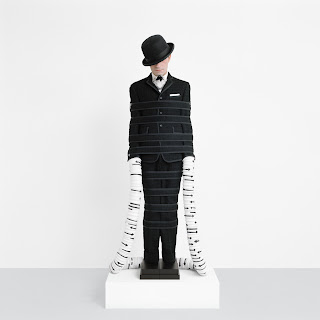
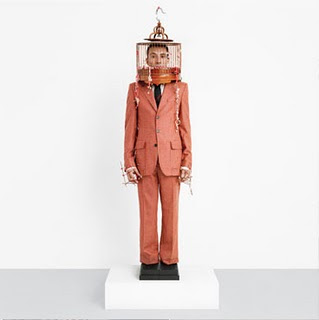
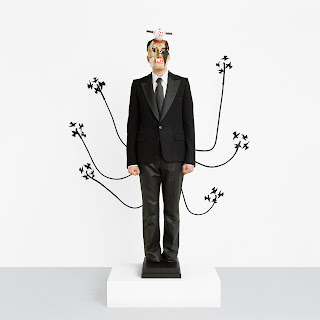
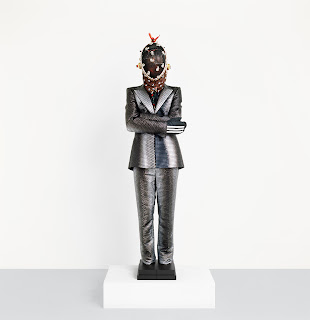
In this artist’s work, close-ups of the face, torso or whole body distance themselves from giant urban posters, the movie screen, the television monitor or phone display to return to the black and white photo of the early 1900s, to the photo album, to the parade of family members, which among the flowers and hats brings the extended family together to celebrate new friendships and new couples. Sequences of faces of men in suits and ties, sailors and soldiers in uniform, reworked in embroidery, from eye sockets to bowties, moustaches, beards, or light and shadow that enhance their charm, are contrasted in the exhibition with sequences of women’s faces that show themselves or hide beneath networks of thick tonal webs of embroidery thread, trying, unseen, to scrutinize a likely interlocutor. The installation of family members on metal pedestals has intense anthropological connotations: the father and mother, symbolic and enigmatic clusters of hair with material faces, their features imploded.
Never ceasing to pick up threads and point out networks that are more intensive than extensive, more affection than effect, Anzeri works on the alleged objectivity of the photograph, on the representation of the face in a redefinition of the portrait, in order to carry out the mise en abyme (infinite duplication) of identity and relationships, to bring to the surface the clandestine presence that dwells in the individual.
Just as seventeenth century painters depicted the vanitas, the symbol of earthly transience, so the Ligurian artist uses his embroidery to cover in glamour and papillon, in seductive masks that are transparent or dense, refined or primitively tribal, in crowns, halos, diadems and flowers, the inevitable presence of the skull, conferring colour and warmth to the gelid and faded face of death.
Oscillating casually and ironically between the delirium of carnival, funereal mourning and the rituals of contemporary mythology, Maurizio Anzeri works at an uninterrupted writing of the labyrinth on the quicksands of identity.